

Bookmark
One can practice the arm test easily with this bookmark.
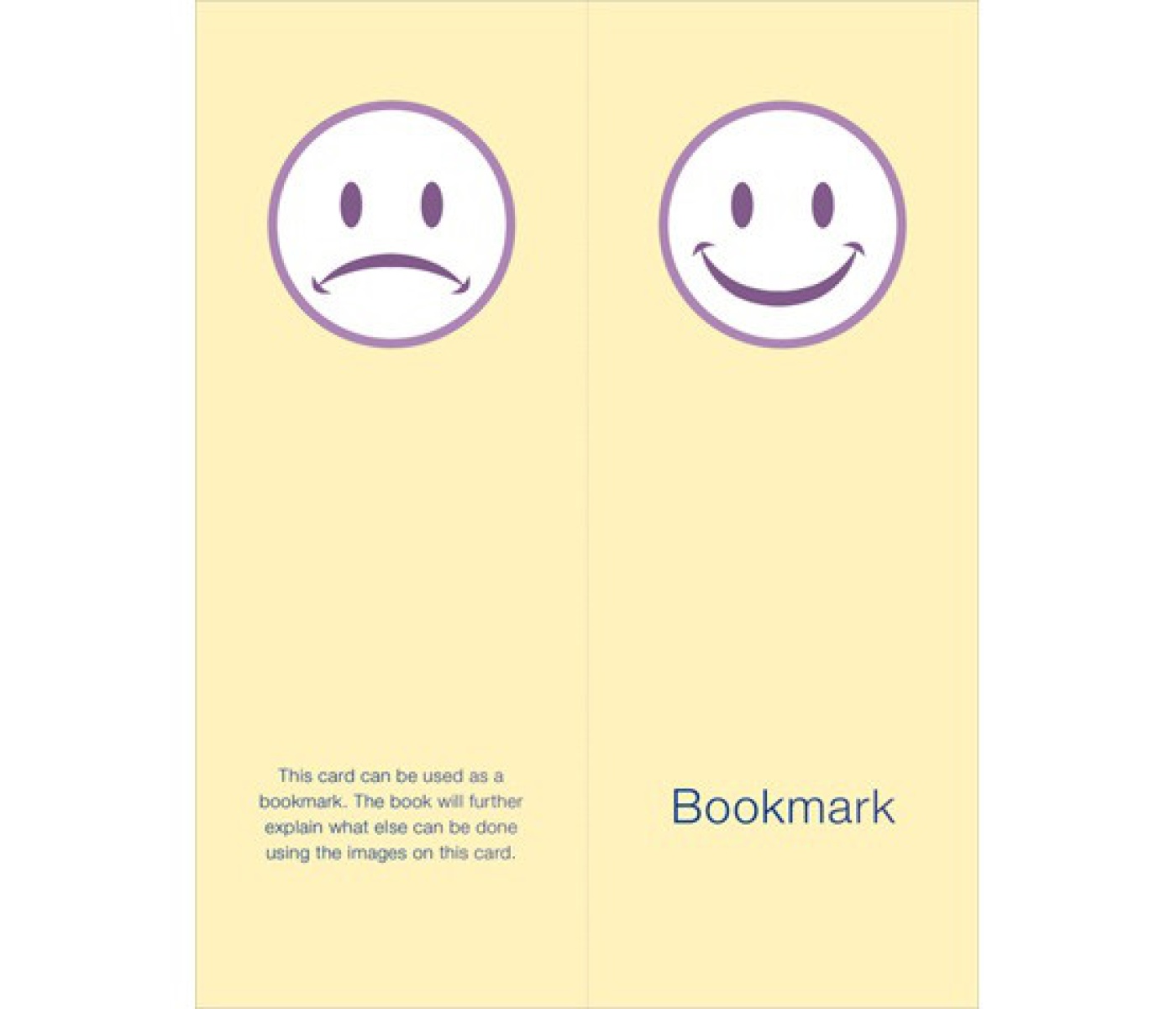
Please download this bookmark, print it and fold it so that one side shows the smiling face and the other, the frowning face.
Instructions for the arm test
Please read the instructions below before practicing the arm test with the help of the bookmark.
Quiet mind
Optimal testing can only be done with a quiet mind. This necessitates the calming of mental chatter, as well as control over the continual stream of thoughts.
This can be relatively easily be achieved by focusing attention on the Ki or Chi point.
The Ki point is situated two fingers below the navel beneath the skin. We can easily direct our attention to this spot by visualizing a golden little ball moving back and forth between the navel and the spinal cord.
It makes a big difference whether or not the person doing the testing is anchored in their Ki point.
Position tester and subject
After being anchored in his or her Ki point, the tester stands opposite the subject so as to be able to place their arm on the subject’s opposite shoulder.
Now the tester asks the person to extend one arm out to the side. The arm and hand, although extended, should be relaxed. It is important not to make a fist. The subject should stand straight with slightly bent, relaxed knees. Should the knees be over extended, they tend to lock which blocks energy flow.
Under pressure
When the subject is ready, standing straight with outstretched arm extended to the side, and knees loosely bent, the tester exerts a gentle downward pressure at the wrist.
It is not a matter of pushing the arm downwards with force nor is it meant for the subject keep their arm horizontal at any cost.
The point is to notice the quality of muscle tone in the arm in response to the question. A strong arm (a ‘yes’ response) can resist the pressure of the test while a weak arm cannot.
The way to pose a question
The tester may pose the question either verbally or mentally. If done non-verbally, the subject needs to be told afterward what the question was.
This is important because the subject entrusts part of the themselves to the tester. Any betrayal of this trust will draw in fear which, needless to say, will influence the results.
It is essential is that that the question is worded in the affirmative. A negatively formulated question or one containing ‘no’ or ‘not’ will not work. So: “Do you think these clothes are not beautiful” is quite normal to say in Dutch. But this cannot be answered with a ‘yes’ or a ‘no’. ‘Yes I don’t like them’ or “No.” I don’t like them’ leaves no room for an answer that says that you like them.
The arm test can only give a ‘yes’ or a ‘no’ answer.
How to use the bookmark
The tester holds the bookmark with the smiling or the sad face directed toward the subject. They test the stretched arm of the subject with the other hand.
In this case there is no need for a question because one is testing the effect of the happy or the sad faces on the bookmark, which encompasses the question.
With practice one will discover that symbols have power. Even the smiling and the frowning face are symbols, which is why their negative or positive effect on us can be tested.
More instruction can be found in appendix IV of the book ‘Spiritually Intelligent Matter’.